
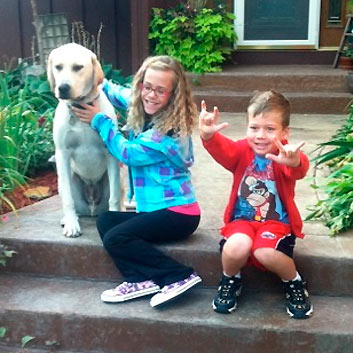
Marja Cassidy (left), like many children with both hearing and vision loss, benefits from specialized, intensive family-centered instruction and one-to-one classroom support from a trained Intervener.
The educational system plays a crucial role in serving the needs of children with combined hearing and vision loss. Children who meet the eligibility guidelines can receive specialized education support, including communications training, from birth to age 21.
Children with combined hearing and vision loss need:
- Early screening and intervention. More than 90% of children who are deafblind have multiple disabilities or health problems. These other disabilities are often given higher priority for intervention or treatment than the child’s hearing and vision loss. However, combined hearing and vision loss will significantly impact the child’s ability to communicate and develop to their full potential.
- Accurate assessment of their physical and cognitive abilities and limitations.
- Intensive, specialized instruction that reflects his or her unique needs and communications abilities.
- Access to specialists who can address specific areas, such as Interveners who are trained to help the child learn to gather information from his or her environment or sign language teachers.
- A unique educational plan that reflects the child’s age, abilities and obstacles. For children under three years, this plan is called an IFSP (Individualized Family Services Plan). For children between the ages of 3 and 21, this plan is called an IEP (Individualized Education Plan). Because children with combined hearing and vision loss often require services from more than one agency, an Individual Interagency Intervention Plan (IIIP) also may be created to coordinate services.
- An IFSP or IEP that identifies a team of specialists who work together to help the child learn effectively. Consider including a teacher of the deaf and hard of hearing and teacher of the blind/visually impaired, therapists, orientation and mobility trainers, interveners, etc.
- To be included in activities with their families, neighbors, caregivers and peers without disabilities.
- To be connected with professionals and educators who understand the complexities of combined hearing and vision loss and encourage the child to become as independent as possible.
- Access to trained interveners who can help them develop communication and language skills, explore their communities and learn how to access information from their environment.
- Family members and caregivers who are trained to communicate with the child.